My mission and vision
“Less busy work. More building.”
That is the mission behind CoderConsole. I want to make everyday developer tasks easier, so developers can spend less time on repetitive work and more time building.
My vision is a useful set of free, straightforward tools developers can trust for quick jobs: formatting JSON, checking a cron expression, comparing text, or converting a timestamp. Privacy is part of that promise. Whenever possible, the tools process input in the browser instead of uploading it to a CoderConsole server.
CoderConsole began as a Blogger archive and has grown into a developer workspace with browser-based tools and practical engineering notes. Here is how I approached that change.
Build AI-natively from the start
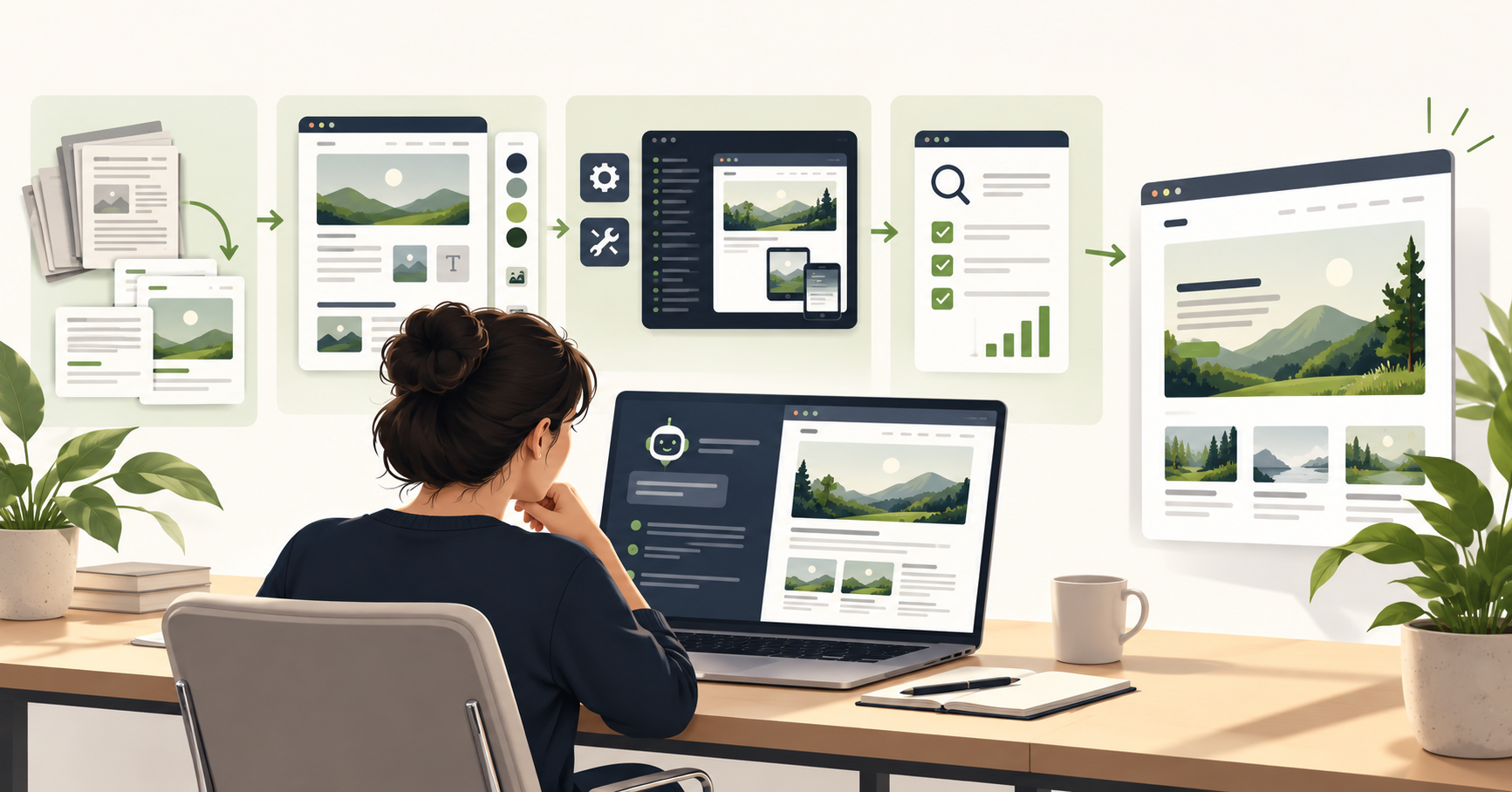
I approached the refactor with AI agents as part of the development workflow, not as a final step for generating code. I divided the work into clear responsibilities—migration, content, SEO, and tools—and gave each one the project context and constraints it needed.
The agents worked through artifacts the next step could use: a route map informed the content migration, the migrated page inventory informed SEO, and the route, navigation, and privacy rules guided the tool work. That made the workflow connected and reviewable. I could inspect an output, correct it, and pass the updated context forward.
The product itself remains lightweight: most tools use browser technologies and do not need an AI model to perform their task. “AI-native” describes how I organized the planning and development work around agents, shared context, and frequent human review.
First, map what needed to survive the migration
I used a Migration Agent to review the Blogger Takeout export and the existing sitemap. That inventory found 27 published posts, three static pages, and the original URLs for each.
Those URLs became a migration constraint: I could change how the site looked, but readers should not lose the links they already had. The export also included 2,805 comments, many appearing to be spam. I left them out of the first release because I did not yet have a moderation plan.
The Migration Agent handed the route map and content inventory to the Content Agent. The Content Agent carried the articles into static pages, preserved their paths, and removed unsafe embedded scripts and outdated ad markup.
Make the content findable
With the routes and pages in place, I used an SEO Agent to review titles, descriptions, canonical URLs, social preview metadata, structured data, and the sitemap. It checked that canonical URLs matched the pages that existed and that the metadata covered the site inventory at that point in the migration.
Keeping the site static made those routes and metadata straightforward to inspect. The deployable site/ directory contains the pages served to visitors, including the preserved archive paths.
Build the tools around privacy
I started the Tools Agent with a small proof of concept: a JSON formatter, Base64 converter, and JWT viewer. Each processed input in the browser, so pasted data stayed off a CoderConsole server.
After I reviewed that foundation, I expanded the tools to cover cron schedules, regex testing, text and JSON diffs, SQL formatting, timestamps, URLs, UUIDs, focus work, and architecture diagrams. Later tools followed shared layout and navigation patterns, with privacy constraints carried forward from the first tools.
CODERCONSOLE TOOLS
Try a tool
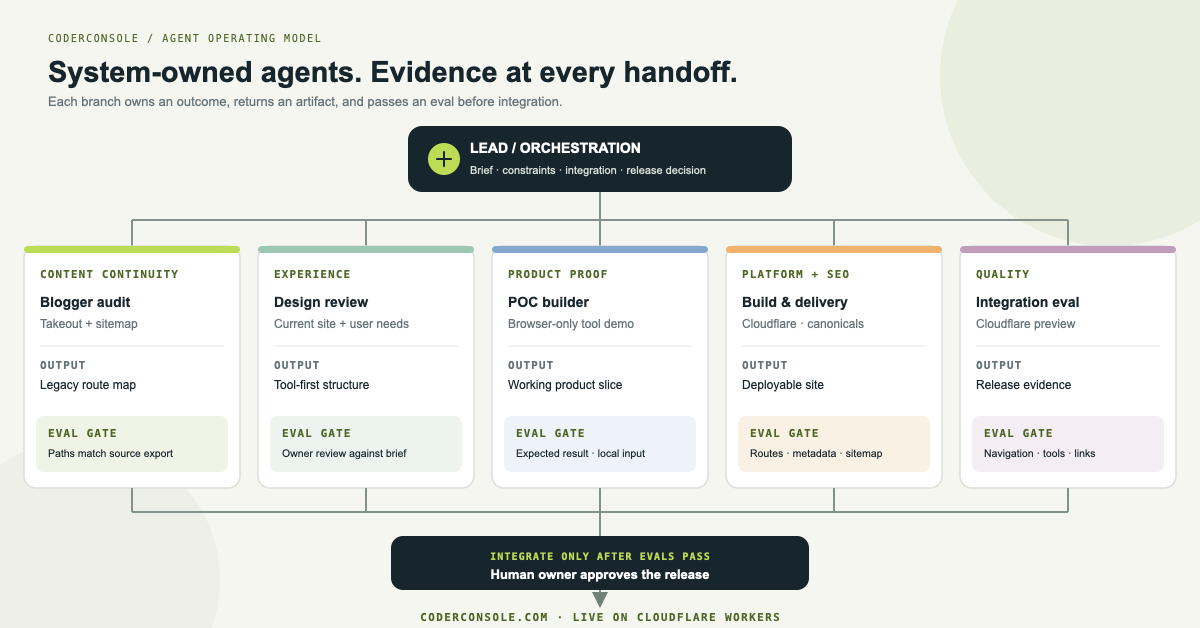
This diagram is a working map for the CoderConsole refactor: focused tasks connect through shared context and review, with me responsible for the final result.
How I used multiple agents together
Each agent had a focused responsibility. Their work connected through concrete handoffs: the route map informed the content migration, the finished page inventory informed SEO, and the resulting route and privacy conventions guided the tools.
When a check found a mismatch, I could send that information back to the part of the work that needed it. Some tasks could happen in parallel, but dependencies stayed clear. I audited routes before migrating content, reviewed the small tools proof of concept before expanding it, and checked the combined site before release.
I kept product decisions and final integration with myself. Agents helped me inspect and move through the work; they did not decide what CoderConsole should promise.
The technology and integrations
I kept the implementation intentionally lightweight:
- Blogger Takeout supplied the old content and route information.
- Python’s standard library powered the optional content-import workflow.
- HTML, CSS, and browser JavaScript power the static site and most tools.
- React and Vite power the isolated Architecture Sketcher experience.
- Cloudflare Workers Static Assets serve the checked-in
site/directory while preserving the older article routes. - GA4 measures site and tool interactions on production pages. Tool inputs and outputs should stay out of analytics.
- Google AdSense supports selected browsing and article pages. Interactive tool workspaces remain ad-free.
Analytics and advertising are integrations around the project, not reasons to weaken its privacy promise. Analytics should never receive tool inputs or outputs, and ads should not interrupt the workbench.
Check the site the way readers use it
I checked the route map against the Blogger source, reviewed the tools for local processing, and checked the integrated pages, links, metadata, navigation, and tool interactions.
One preview check caught a useful mismatch: /tools/focus/ appeared in the sitemap and the page existed in the repository, but the preview returned a 404. That reminded me to check actual served routes, not just files on disk. Keeping an article page is not enough if its original URL no longer works.
What I learned
The value of multiple agents was not simply producing more code. It was breaking a large refactor into connected tasks with clear handoffs, so I could spend less time coordinating repetitive work and more time reviewing the product itself.
The process that worked for me was:
- Start with evidence about the existing site.
- Give each agent a focused responsibility.
- Pass routes, constraints, and findings between tasks.
- Review a small proof of concept before expanding it.
- Check the integrated site through real routes and interactions.
- Keep product and release decisions with a human owner.
CoderConsole is still growing. My goal remains simple: less busy work, more building, with privacy considered from the start.